
Wellness and Artificial Intelligence: Possible Allies or Distant Worlds?

When we talk about wellness, the mind immediately goes to images of relaxation, care, and time for oneself. A massage, a deep breath, the silence after a full day.
All profoundly human experiences.
But today, as we live in an era where technology is changing every sector, even wellness faces a new question:
what role can artificial intelligence play in our work and in the way we experience wellness?
No, we’re not talking about robots giving massages or machines replacing hands.
We’re talking about intelligent tools that can amplify the value of our work, enhance the customer experience, and open new possibilities—while always keeping human contact at the center.
What is AI and why is it so talked about today?
Artificial intelligence is not science fiction: it is a technology that “learns” from data and performs actions that, until recently, we could only imagine being done by humans.
In the world of health and wellness, AI is stepping in carefully—but with enormous potential.
It’s not here to replace us, but to simplify, personalize, and optimize.
And for those who work in wellness, it can become a valuable resource if used with intelligence and sensitivity.
How can AI enter the world of wellness?
Here are some concrete—and perhaps still little-known—ways in which artificial intelligence is beginning to integrate into our sector.
1. Personalization of treatments
Thanks to AI-based tools, it is already possible to analyze a person’s specific needs through questionnaires, biometric analyses, or data collected from apps and wearable devices (like smartwatches and fitness trackers).
This information can help the practitioner customize each treatment, creating a truly tailor-made experience.
2. Supporting the client relationship
Many professionals already use software that reminds them of appointments, manages feedback, or tracks customer preferences.
AI can make these tools smarter, helping anticipate needs or subtly—but effectively—suggest complementary treatments.
3. Apps and virtual assistants for daily wellness
There are already AI-driven apps offering personalized meditations, breathing exercises, nutritional advice, and sleep monitoring.
A modern wellness practitioner can recommend these tools to clients, expanding their service beyond direct treatments.
4. Training and professional development
AI also serves professionals: it can help create personalized learning paths, provide real-time updated content, translate materials from other languages, and facilitate access to new international knowledge.
Some real examples (you might not know)
-
In Japan, some spas use AI to analyze a client’s movements during a massage, suggesting posture improvements to continue at home.
-
In Sweden, there are platforms that combine data on mental health, stress, and sleep quality to offer personalized self-care advice (and even suggest a massage!).
-
In the United States, several companies have started integrating AI-guided wellness programs into employee wellness initiatives, with great success.
Artificial intelligence cannot do everything
But there is something no artificial intelligence can ever replicate.
The way you enter a client’s home, the silence you create during a treatment, the intuition guiding you to adjust pressure or say one more word…
These are not “functions.” They are presence, listening, experience, heart.
AI can suggest. You can feel.
It can advise. You can perceive.
It can organize. You can welcome.
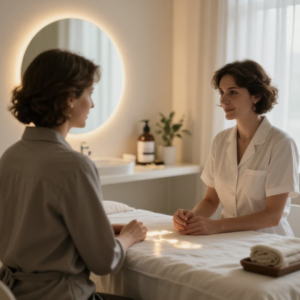
The future will be (also) technological. But deeply human.
Technology, like AI, is not an enemy for those who work in wellness.
It is an additional opportunity to improve service quality, work organization, and communication with clients.
But only if it remains at the service of the human experience, and not the other way around.
I, at Wellnessaround, believe that wellness is a living language, made of hands, words, glances, and intuition.
And if today we can use new tools to listen better, understand better, and care more, then so much the better.
The question is not: “Will AI replace us?”
The question is: “How can we collaborate with it to offer an even deeper, more respectful, and authentic experience?”
Do you want to stay updated on the world of wellness, between innovation and tradition?
Follow me or write to me at wellnessaround.com and don’t miss the upcoming articles.
Wellnessaround – wherever you are!